Tenzo
MCP Server Docs
Model Context Protocol

Tenzo MCP Server

Query your restaurant analytics, reviews, and manager logs using natural language through any MCP-compatible AI assistant.

What you can do

The Tenzo MCP server gives AI assistants access to your restaurant data through seven tools:

📊

Query Metrics

Sales, labour cost, covers, transactions — grouped by location, day, or category.

List Reviews

Customer reviews from Google, TripAdvisor, and other platforms, with ratings and text.

📝

List Logs

Manager logs and shift notes, filterable by location and date range.

The AI also calls these helper tools automatically at the start of each conversation:

Read-only data. It cannot modify your data, only your Tenzo configuration.

Setup

Choose your AI client below. You'll be asked to sign in to your Tenzo account the first time you connect.

Ensure Tenzo is added as a connector

Tenzo is a custom connector. If you don't see it in your list, ask an admin to add it from claude.ai/admin-settings/connectors, pointing at https://ai.gotenzo.com/mcp.

Open Connectors settings

Navigate to claude.ai/customize/connectors.

Connect Tenzo

Find Tenzo in the list and click Connect.

Authorize

You'll be redirected to sign in with your Tenzo account. Once authorized, the connector will appear as active in your settings.

Start chatting

Open a new conversation on claude.ai and ask about your restaurant data.

Ensure Tenzo is added as a connector

Tenzo is a custom connector. If you don't see it in your list, ask an admin to add it from claude.ai/admin-settings/connectors, pointing at https://ai.gotenzo.com/mcp.

Open Settings

In Claude Desktop, open Settings and navigate to the Connectors section.

Connect Tenzo

Find Tenzo in the list and click Connect.

Authorize

A browser window will open for you to sign in with your Tenzo account. Once authorized, return to Claude Desktop.

Start chatting

Open a new conversation and ask about your restaurant data. You should see the Tenzo tools available in the tools menu.

Add the server

Run the following command in your terminal:

claude mcp add --transport http tenzo https://ai.gotenzo.com/mcp/

Start chatting

Start a new conversation and ask something like "What were my sales last week?". You'll be prompted to authorize via OAuth on first use.

We've applied for a public ChatGPT App listing. In the meantime, you can use our CustomGPT.

Open the Tenzo CustomGPT

Visit the Tenzo CustomGPT and start a conversation.

Authorize

You'll be prompted to connect your Tenzo account on first use.

Once the public ChatGPT App is approved, we'll update these instructions with a simpler setup process.

Open your settings file

Edit ~/.gemini/settings.json (create it if it doesn't exist).

Add the Tenzo MCP server

{
  "mcpServers": {
    "tenzo": {
      "url": "https://ai.gotenzo.com/mcp"
    }
  }
}

Start a conversation

Launch the Gemini CLI and ask a question about your restaurants. You'll be prompted to authorize via OAuth on first use.

Any MCP-compatible client can connect to the Tenzo server using:

SettingValue
Server URLhttps://ai.gotenzo.com/mcp/
TransportStreamable HTTP
AuthenticationOAuth 2.0 (handled automatically)

If your client doesn't support remote MCP servers natively, use the mcp-remote bridge:

npx -y mcp-remote https://ai.gotenzo.com/mcp/ --transport http-first

Adding a connector in Claude

If your organization doesn't have the Tenzo connector yet, an admin can add it in a few steps:

Open the admin connectors page

Navigate to claude.ai/admin-settings/connectors.

Add a custom connector

Scroll to the bottom and click Add Custom Connector.

Enter the details

Type Tenzo as the name and enter the following as the Remote MCP server URL:

https://ai.gotenzo.com/mcp

Save

Click Add. The Tenzo connector will now be available to all members of your organization in their Connectors settings.

Authentication

The Tenzo MCP server uses OAuth 2.0. The first time you connect from a new client, you'll be redirected to Tenzo's login page to sign in. After that, your session is cached and you won't need to sign in again until the token expires.

The MCP server only has access to data your Tenzo account can already see — it respects your existing permissions and business access.

Example questions

Once connected, try asking your AI assistant things like:

CategoryExample
Sales“Show me the revenue impact if my bottom 3 locations matched the upselling rate of my top performer.”
Labour“On my highest COL % days, what did my GMs log? Is there a pattern in the reasons given?”
Inventory“What's my waste cost per location this week, and which sites are outliers?”
Reviews“What are the 5 most common negative themes in my reviews over the last 90 days, and which locations appear most frequently?”
Combined“On my worst-reviewed days, what did labour, covers, and average spend per head look like vs my best-reviewed days?”

Troubleshooting

Connecting

"Missing or invalid OAuth token" error

Your session has expired or the initial OAuth flow didn't complete. Try:

  1. Restart your AI client to trigger a fresh OAuth login.
  2. Check that you completed the Tenzo sign-in page when prompted.
  3. Ensure your Tenzo account is active and has access to at least one business.
Claude Web/Desktop: Tenzo isn't in my connectors list

Tenzo is added as a custom connector — it doesn't appear in Claude's built-in directory. If you don't see it, an admin needs to add it. See Adding a connector in Claude.

Claude Code: connection refused
  1. Confirm the server was added: claude mcp list
  2. Remove and re-add if needed: claude mcp remove tenzo then re-add.
  3. Check you can reach the server: curl https://ai.gotenzo.com/ should return a JSON status response.
Gemini CLI: not connecting
  1. Verify ~/.gemini/settings.json is valid JSON.
  2. Restart the Gemini CLI after saving changes.
  3. Check you can reach the server: curl https://ai.gotenzo.com/

Using

Tool calls are failing

If the connector is already authorised but tool calls are erroring or returning the wrong data, try these in order:

  1. Start a new chat — fixes most issues by clearing stale tool schemas and session state.
  2. Ask your AI to refresh the tools — e.g. "refresh Tenzo tools". Keeps the current conversation context if that matters.
  3. Re-run the analytics context check — if tools load but data looks wrong or requests fail with a business ID error. Ask the AI to run get_analytics_context.
  4. Disconnect and reconnect — for persistent auth or schema issues that survive a new chat. Remove Tenzo from your client's connector settings, then add it back.
"Public API error 403" or permission errors

Your Tenzo account doesn't have access to the requested data. Check with your Tenzo administrator that your account has the correct permissions and business access.

Data looks wrong or incomplete

The MCP server returns data from Tenzo's Public API, which reflects what you see in the Tenzo dashboard. If numbers don't match your expectations:

  1. Check the date range — the AI may interpret "last week" differently to what you expect.
  2. Verify the metric name — ask the AI to list available metrics first.
  3. Check for filters — the query may be scoped to a specific location.

Need help?

If you're still having trouble, contact Tenzo support at support@gotenzo.com with:

• Which AI client you're using (Claude, ChatGPT, Gemini, etc.)
• The error message or unexpected behaviour
• Your operating system
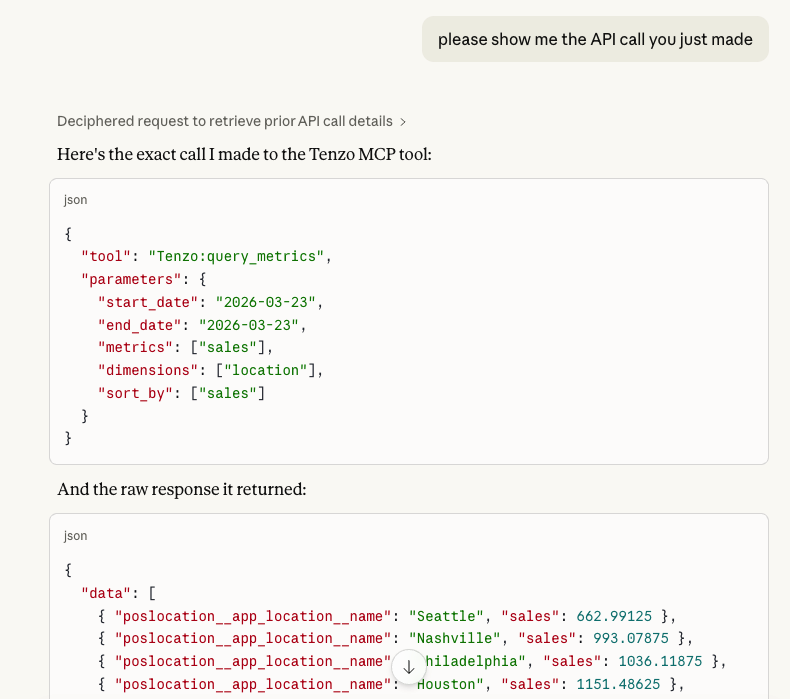
• The specific API request that was made (see below)

Including the API request

When submitting a support request, it is very helpful if you include the specific API call that was made. Ask your AI client something like "please show me the API call you just made" — it will show the tool name, parameters, and raw response.

Example of asking your AI client to show the API call it made